I'll let you make up your own mind with this one.
Monday, 31 December 2012
New solution floated for the Maldives
No it's not quite the 1st of the month just yet. It's not even April! But the apparent appearance of this idea to be some kind of April fool's joke is too tempting. Nevertheless, the idea does appear to be an environmentally friendly option due to the collaboration with nature but it would come at a high price. The Maldive government have hired the Dutch architecture firm Waterstudio to design a series of floating islands as a solution to the effects of climate change.
I'll let you make up your own mind with this one.
I'll let you make up your own mind with this one.

Sunday, 30 December 2012
The Maldives under invasion
As alluded to in my previous post, the Maldives is an island nation seriously threatened at present by ongoing changes to the climate and the oceans. Mohamed Nasheed, president from 2008 to 2012, was interviewed for the short film below, Small Islands, Big Impact, in which he speaks of his nation’s plight and asks for much needed international efforts of cooperation and change. He notes problems of coastal erosion as well as reductions in tuna catches due to warming oceans. The injustice of the situation has been realised now that the people know that the part they play in causing the change is tiny compared to the rest of the world.
Not only does Nasheed feel that climate change is a human rights issue, he also argues for its case quite understandably as an environmental issue, but also as a security issue. Consequently, he likens international support for Poland in the 30s, and Vietnam in the 50s and 60s, to the defence needed for his nation today. During his Presidency, he attempted to mitigate climate change and bring it to the public’s attention by appearing on American TV shows such as The Daily Show and the Late Show with David Letterman.
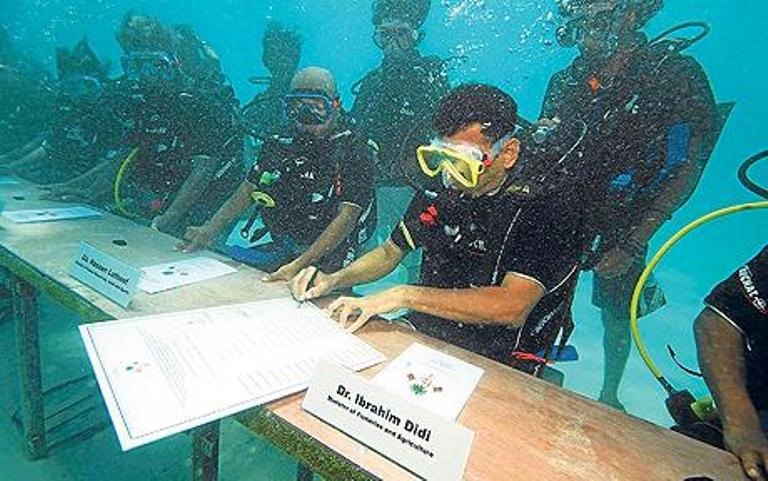 |
| Maldives underwater conference a publicity stunt |
Ahead of the 2009 UN climate change conference in Copenhagen, an underwater conference was held in which Maldivian ministers signed a document calling for other nations to cut their carbon emissions (BBC 2009). Quite importantly, at the 2009 climate talks, plans were announced by Nasheed to eliminate or offset all of the nations greenhouse gas emissions by the year 2020! You may this is a massive change but it is supported by the argument that:
"For us swearing off fossil fuels is not only the right thing to do, it is in our economic self-interest…Pioneering countries will free themselves from the unpredictable price of foreign oil; they will capitalize on the new green economy of the future, and they will enhance their moral standing giving them greater political influence on the world stage." (President Mohamed Nasheed 2009)
Migration is, and has been, an option for those at risk of rising sea levels in the Maldives. In 2008 Nasheed announced plans to purchase land in Sri Lanka, India, and even Australia as a result (Ramesh 2008). This though would obviously come at a great price, both financially and culturally. He explained his reasoning for these quite significant plans:
“We do not want to leave the Maldives, but we also do not want to be climate refugees living in tents for decades”
Efforts therefore have also seen the building of a 3 metre high concrete wall around the capital, Malé, at a cost of $63 million which was effectively paid for with Japanese aid money (BBC 2004). Additionally, forestation efforts have been implemented in order to reduce the effects of coastal erosion while environmental science is given high priority in all schools.
While traditionally attempts at adaptation have seen the building of physical barriers to the sea, Nasheed believes the most important issue today is that of good governance. The Maldives has recently become a democracy and without this system of good governance, he feels that vital resources would be wasted in the future when the impacts of climate change intensify.
References
BBC (2004) ‘Maldives: paradise soon to be lost’ (WWW), London: BBC News (http://news.bbc.co.uk/1/hi/world/south_asia/3930765.stm; 30 December 2012).
BBC (2009) ‘Maldives cabinet makes a splash’ (WWW), London: BBC News (http://news.bbc.co.uk/1/hi/8311838.stm; 30 December 2012).
Nasheed, M. (2009) ‘Climate change gridlock: where do we go from here? part 1’ (WWW), Oakland, CA: Radio Project (http://www.radioproject.org/2011/06/climate-change-gridlock-where-do-we-go-from-here-part-1; 30 December 2012).
Ramesh, R. (2008) ‘Paradise almost lost: Maldives seek to buy a new homeland’ (WWW), London: The Guardian (http://www.guardian.co.uk/environment/2008/nov/10/maldives-climate-change; 30 December 2012).
Friday, 28 December 2012
Will it be Paradise Lost?
What comes to mind when you think of the Maldives? You might be thinking an exotic holiday destination? Tropical islands, beautiful coral reefs, and long white sandy beaches. Hotels on stilts stretching out into the Indian Ocean? Paradise? Or even those islands which constantly crop up in the news as hotspots feeling the effects of climate change?
The problem is that the Republic of the Maldives, as it is formally known, is the flattest country on Earth. Made up of 1,192 islands and home to a population of over 328,000, the Maldives and its people are extremely vulnerable to changes in sea level. For them, the prospect that the majority of their land surface could be underwater by the end of the century is very real (Woodworth 2005). While no point exceeds 3 metres elevation, much of the land surface (80%) lies below 1 metre above sea level.
Of the 1,1192 islands, 358 are inhabited, yet much of the population live close to the capital Malé located on the North Malé Atoll. In fact, about one-third of residents live there making it an excessively densely populated island (NAPA 2007). As alluded to above, tourism plays a major role in the local economy with over 600,000 tourist visits per year but this brings with it its own burdens on local communities (Tol 2007).
Sea level rise threatens homes, businesses and infrastructure that are forced to locate on the coast. As you know, sea levels are rising and it is on islands like these that miniscule changes can have major effects in the form of land inundation. For example, over 90 of the inhabited islands experience annual flooding (NAPA 2007). Another issue is freshwater resources which are scarce due to the shallow groundwater aquifers that are themselves at risk of seawater inundation with increased extraction. The government provides freshwater to 87% of the population through rainwater collection but during the dry season, and for non-drinking purposes, water is still required (UNEP 2005).
Scientists have suggested that 77% of the land would be lost by 2100 if mid-level estimates of sea level rise, 0.5 metres, are realised (Woodworth 2005). If this was exceeded and the country experienced a 1 metre rise it would have almost disappeared underwater by 2085! Serious measures have to be taken. Measures which the Maldive government are taking as their primary concern in addition to efforts to highlight the threat climate change poses in order for global community action. These attempts of mitigation and adaption will be examined next time.
References
 |
| Figure 1. Paradise in the Maldives? |
The problem is that the Republic of the Maldives, as it is formally known, is the flattest country on Earth. Made up of 1,192 islands and home to a population of over 328,000, the Maldives and its people are extremely vulnerable to changes in sea level. For them, the prospect that the majority of their land surface could be underwater by the end of the century is very real (Woodworth 2005). While no point exceeds 3 metres elevation, much of the land surface (80%) lies below 1 metre above sea level.
Of the 1,1192 islands, 358 are inhabited, yet much of the population live close to the capital Malé located on the North Malé Atoll. In fact, about one-third of residents live there making it an excessively densely populated island (NAPA 2007). As alluded to above, tourism plays a major role in the local economy with over 600,000 tourist visits per year but this brings with it its own burdens on local communities (Tol 2007).
Sea level rise threatens homes, businesses and infrastructure that are forced to locate on the coast. As you know, sea levels are rising and it is on islands like these that miniscule changes can have major effects in the form of land inundation. For example, over 90 of the inhabited islands experience annual flooding (NAPA 2007). Another issue is freshwater resources which are scarce due to the shallow groundwater aquifers that are themselves at risk of seawater inundation with increased extraction. The government provides freshwater to 87% of the population through rainwater collection but during the dry season, and for non-drinking purposes, water is still required (UNEP 2005).
 |
| Figure 2. Reality many increasingly face |
Scientists have suggested that 77% of the land would be lost by 2100 if mid-level estimates of sea level rise, 0.5 metres, are realised (Woodworth 2005). If this was exceeded and the country experienced a 1 metre rise it would have almost disappeared underwater by 2085! Serious measures have to be taken. Measures which the Maldive government are taking as their primary concern in addition to efforts to highlight the threat climate change poses in order for global community action. These attempts of mitigation and adaption will be examined next time.
References
NAPA (2007) ‘National adaptation programme of action’, Ministry of Environment, Energy and Water: Republic of Maldives.
Tol, R.S.J. (2007) ‘The double trade-off between adaptation and mitigation for sea level rise: an application of FUND’, Mitigation and Adaptation
Strategies for Global Change, 12, 741–53.
Strategies for Global Change, 12, 741–53.
UNEP (2005) ‘Maldives post–tsunami environmental assessment’, UN Environmental Programme, Nairobi, Kenya.
Woodworth, P.L. (2005) ‘Have there been large recent sea level changes in the Maldive Islands?’, Global and Planetary Change, 49, 1-18.
Wednesday, 26 December 2012
West Antarctic Ice Sheet warming raises sea level fears
So thankfully the world didn't come to a dramatic end this week as the Mayan's had (possibly) predicted all those years ago. What is not such great news is that a new article published online a few days ago, just to lighten up our Christmases, has shone a great deal of attention to Antarctic warming and global sea level rise.
The Bromwich et al. (2012) study in Nature Geoscience attempted to iron out uncertainties over the magnitude, seasonality and extent of warming that is widely assumed to have been occurring in the West Antarctic region since the 1950s. The problem was that temperature records relied on observations from the Bryd Station, found in the centre of the West Antarctic Ice Sheet, which were incomplete. The new research used computer modelling and analysis of the atmosphere to fill in these gaps.
 |
| Figure 1. Antarctica |
It has been found that the region is warming twice as fast as was previously thought. The report noted a ‘linear increase in annual temperature between 1958 and 2010 by 2.4 ± 1.2 °C’, which makes it one of the most rapidly warming regions of the world (Bromwich et al. 2012). Interestingly, and what is of great importance, is that summer temperatures were found to be increasing. This has implications for surface melting of the ice sheet. It has previously been suggested that warm ocean currents were the main contributor of ice loss in the West Antarctic (Pritchard et al. 2012). Thus basal, rather than surface melting, was thought to be key. Now, one can only speculate that surface melting will play a greater role to accelerate ice sheet loss.
I feel that the implications this could have on global sea level are enormous. There is obviously the direct impact of increased meltwater making a greater contribution to sea level rise. However, there is also the indirect effect that this melt could have which would be similar to the collapse of the Larsen B ice shelf in 2002. If the ice shelves were to collapse natural ice flow which is normally restrained, in glaciers for example, would be released into the ocean (Bromwich 2012).
This is one of the reasons the region has had so much attention - if all of the West Antarctic Ice Sheet were to melt sea level would rise by over 3 metres (BBC 2009)! While this may make recent changes appear miniscule in comparison, this should not be a reason to give up home in the battle against sea level rise. Instead, it should feed greater impetus for the war on anthropogenic climate change so that these drastic conditions are not realised.
References
BBC (2009) ‘Ice sheet melt threat reassessed’ (WWW), London: BBC News (http://news.bbc.co.uk/1/hi/sci/tech/8050094.stm; 26 December 2012).
Bromwich, D. (2012) ‘‘Study shows rapid warming on the West Antarctic Ice Sheet’ (WWW), Ohio: The Ohio State University Research News (http://researchnews.osu.edu/archive/byrdwarm.htm; 26 December 2012).
Bromwich, D.H., J.P. Nicolas, A.J. Monaghan, M.A. Lazzara, L.M. Keller, G.A. Weidner and A.B. Wilson (2012) ‘Central West Antarctica among the most rapidly warming regions on Earth’ (WWW), Nature Geoscience (http://www.nature.com/ngeo/journal/vaop/ncurrent/full/ngeo1671.html; 26 December 2012).
Pritchard, H.D., S.R.M. Ligtenberg, H.A. Fricker, D.G. Vaughan, M.R. van den Broeke and L. Padman (2012) ‘Antarctic ice-sheet loss driven by basal melting of ice shelves’, Nature, 485, 7395, 502-5.
Sunday, 9 December 2012
The Ganges Delta - Sink or Swim?
The Ganges Delta, located in Southern Asia, covers parts of Bangladesh and the Indian state of West Bengal. Due to the densely populated nature of the region the delta, which covers around 87,300 km², is home to almost 111 million people (Ericson et al. 2005). It is no surprise then that it is the world’s most populated delta. The problem is that sea level rise, accelerated by the effects of global warming, is placing enormous stresses on the region’s already pressured land, water, and food resources.
As I have previously discussed, global sea level rise is increasing and it is placing certain areas at greater risk due to the non-uniform pattern of change around the world. Bangladesh is extremely vulnerable to change as much of the country is covered by river plains and the coastal zone lies mostly below 5 metres elevation (Mohal et al. 2006). Parts of the delta have observed a local sea level rise of 25 mm/year which is in part due to their subsiding nature that results in relative changes (Ericson et al. 2005).
Humans have a direct role to play on this local scale as groundwater extraction can increase rates of subsidence (Ericson et al. 2005). Additionally, negative impacts on the environment come as a result of activities such as shrimp farming and river damming. Dams retain sediment which could help reduce subsidence downstream and also decrease the amount of freshwater that this land receives (IPCC 2007).
One of the key worries is that sea level rise will lead to ground and surface waters becoming increasingly saline. Saltwater intrusion could result in the displacement of plant and animal species in the coastal zone that rely on fresh or brackish water (IPCC 2007). Additionally, the salt water could increase the salinity of the presently fertile soil so that crops are endangered, as well as running the risk of food insecurity. With increased soil salinity, the growth of rice is inhibited and thus the yield is reduced (Castillo et al. 2003). Currently, the country’s rice crop is the world’s 4th largest so any changes could have a major implications for the nation which rely upon it (FAOSTAT 2012).
Another issue is the loss of land which has been predicted as a result of rising sea levels and subsidence. It has been predicted that 3 million people would be affected by changes by 2050 and a worse-case scenario is that by 2100, almost ¼ of Bangladesh’s land area (in 1989) could be lost (Castillo et al. 2003). This is a massive amount of land which is presently home to millions of people. The implications for this densely populated region would be enormous.
It should be noted that global warming is not just affecting sea levels in the region. Changes in the climate such as more variable precipitation could lead to more frequent flooding and droughts, as well as increased saltwater intrusion during the dry season (Mohal et al. 2006). Rising temperatures could also see rice production fall 8% by 2050 and wheat by 32% (Faisal and Parveen 2004). What can local people do to change these outcomes? At the moment the future looks uncertain and solutions are needed fast.
References
 |
| Figure 1. Location of the Ganges Delta |
As I have previously discussed, global sea level rise is increasing and it is placing certain areas at greater risk due to the non-uniform pattern of change around the world. Bangladesh is extremely vulnerable to change as much of the country is covered by river plains and the coastal zone lies mostly below 5 metres elevation (Mohal et al. 2006). Parts of the delta have observed a local sea level rise of 25 mm/year which is in part due to their subsiding nature that results in relative changes (Ericson et al. 2005).
 |
| Figure 2. Satellite image of the delta |
One of the key worries is that sea level rise will lead to ground and surface waters becoming increasingly saline. Saltwater intrusion could result in the displacement of plant and animal species in the coastal zone that rely on fresh or brackish water (IPCC 2007). Additionally, the salt water could increase the salinity of the presently fertile soil so that crops are endangered, as well as running the risk of food insecurity. With increased soil salinity, the growth of rice is inhibited and thus the yield is reduced (Castillo et al. 2003). Currently, the country’s rice crop is the world’s 4th largest so any changes could have a major implications for the nation which rely upon it (FAOSTAT 2012).
Another issue is the loss of land which has been predicted as a result of rising sea levels and subsidence. It has been predicted that 3 million people would be affected by changes by 2050 and a worse-case scenario is that by 2100, almost ¼ of Bangladesh’s land area (in 1989) could be lost (Castillo et al. 2003). This is a massive amount of land which is presently home to millions of people. The implications for this densely populated region would be enormous.
It should be noted that global warming is not just affecting sea levels in the region. Changes in the climate such as more variable precipitation could lead to more frequent flooding and droughts, as well as increased saltwater intrusion during the dry season (Mohal et al. 2006). Rising temperatures could also see rice production fall 8% by 2050 and wheat by 32% (Faisal and Parveen 2004). What can local people do to change these outcomes? At the moment the future looks uncertain and solutions are needed fast.
References
Castillo, E., T.P. Tuong, H.T.T. Trang, T.N.Q. Phuong (2003) ‘Phenological and physiological responses of a rice cultivar to level and timing of salinity stress’, in N. Preston and H. Clayton (eds) Rice-shrimp farming in the
Mekong Delta: Biophysical and Socioeconomic issues, Canberra: Australian Centre for International Agricultural Research.
Ericson, J.P., C.J. Vorosmarty, S.L. Dingman, L.G. Ward and M. Meybeck (2005) ‘Effective sea-level rise and deltas: causes of change and human dimension implications’, Global Planetary Change, 50, 63-82.
Faisal, I.M. and S. Parveen (2004) ‘Food security in the face of climate change, population growth and resource constraints: implications for Bangladesh’, Environmental Management, 34, 487-498.
FAOSTAT (2012) ‘Production, crops, Bangladesh’ (WWW), Food and Agriculture Organisation of the United Nations (http://faostat3.fao.org/home/index.html#VISUALIZE; 8 December 2012).
IPCC (2007) Climate Change 2007: Impacts, Adaptation and Vulnerability, Contribution of Working Group II to the Fourth Assessment Report of the Intergovernmental Panel on Climate Change, Cambridge: Cambridge University Press.
Mohal,N., Z.H. Khan and N. Rahman (2006) ‘Impact of sea level rise
on coastal rivers of Bangladesh’, Coast, Port and Estuary Division, Institute
of Water Modelling, Bangladesh.
Wednesday, 5 December 2012
Climate Hotspots
This interactive map, known as Climate Hot Map, shows the impacts that global warming is having on different places around the world. As it is interactive...it is by definition, fun! You are able to check boxes on and off in order to look at the different climatic effects listed in 5 categories: People, freshwater, oceans, ecosystems, and temperature. For myself and the purposes of this blog, it is both useful and interesting to uncheck all of the boxes apart from ‘sea level’ so that you are left with the display shown below.
The website attempts to place the spotlight on several selected locations in different regions of the world which are showing the effects of climate change and that are also well studied. Thus, many parts of the world, notably outside of North America and Europe, receive less coverage. Additionally, as well as each site having robust scientific evidence, they also suffer multiple stresses from human activity, and have, or are projected to be affected by multiple climate change impacts (UCS 2011).
The places chosen with sea level rise as their primary concern are:
For each, information is provided from a range of sources about the impacts as well as offering links to regional solutions of the problems faced.
References
 |
| Click map to visit the web page. |
The website attempts to place the spotlight on several selected locations in different regions of the world which are showing the effects of climate change and that are also well studied. Thus, many parts of the world, notably outside of North America and Europe, receive less coverage. Additionally, as well as each site having robust scientific evidence, they also suffer multiple stresses from human activity, and have, or are projected to be affected by multiple climate change impacts (UCS 2011).
The places chosen with sea level rise as their primary concern are:
- Brazil: Recife
- Guyana
- Japan: Osaka
- Mexico: Cancun
- Republic of Maldives
- Republic of Kiribati
- USA: New York City, New York
Virginia Beach, Virginia
Mississippi Delta, Louisiana
For each, information is provided from a range of sources about the impacts as well as offering links to regional solutions of the problems faced.
References
UCS (2011) ‘Climate hot map: global warming effects around the
world’ (WWW), Cambridge, MA: Union of Concerned Scientists (http://www.climatehotmap.org; 4 December 2012).
Friday, 30 November 2012
BANNED - Sea Level Rise
"Let all men know how empty and worthless is the power of kings. For there is none worthy of the name but God, whom heaven, earth and sea obey."
Does everyone know the legend of Canute the Great, Viking king of Denmark, England, and Norway around 1000 AD? The man who, in an attempt to dispel the myth that he was all-powerful (as well as showing piety), placed his throne on the shore and ordered the sea level to not rise up to him (BBC 2011). When it ignored his order, as he had wanted, his point was made and others could see the limitations of humans.
Why then do some lawmakers in several American states believe that they can tell the oceans to stop rising? Do they feel, as Canute did, that they are receiving too much praise and flattery? Or do they simply believe that they can control the oceans?
Seemingly a wave of sea level denial has spread across the American South. If your state is at risk of sea level rise you might want to avoid what legislators and state officials in Texas, Virginia, and North Carolina have proposed.
Efforts to legislate away the threat and reality of sea level rise began in Texas last year. The Texas Commission on Environmental Quality commissioned a scientific study of a section of Texas’ coastline. The problem was that the Commission didn’t approve of references to sea level rise and so had them removed from the report (Grimm 2012). Incredibly, author of the study John Anderson, who has like his fellow authors asked to have his name removed from the paper, said that “they actually omitted whole sentences that mentioned sea level rise.”
Similarly, in June a study looking at the effects of climate change on Virginia’s coastline was only approved by its General Assembly after references to ‘sea level rise’ and ‘climate change’ had been removed from the $50,000 report (Leber 2012). Instead, it used approved terms such as ‘recurrent flooding’. What reason could be given for this? Well, the one given by the Republican State Delegate Chris Stolle is that the omitted terms would simply politicise the report as ‘sea level rise is a left-wing term”.
It is not the case that Virginia has escaped the impact of rising sea levels though. Norfolk, Virginia spends around $6 million/year improving drainage as well as elevating housing and roads (BBC 2012). Additionally, during storms 5-10% of the city receives heavy flooding. Responses to these problems, and repair of the naval base, surprisingly make no mention of climate change or sea level rise.
Seb Hall, a follower of the blog, recently brought the video clip below to my attention. The news report takes a comedic slant to discuss the attempts by east coast legislators to ban the phrase ‘sea level rise’ and by doing so in my opinion, highlight how ludicrous the measures seem to be.
North Carolina is also mentioned and there is good reason for this. In June, policy makers that didn’t like the impact that predictions of a 1 metre rise in sea level would have on the state’s business interests wrote a law to control how it is measured. The bill says that:
You may find it amusing to read Scott Huler’s blog in which he rants about these measures. I have picked out one of my favourite sections for you to read:
Thankfully, a week after passing through the North Carolina Senate international public criticism of the law saw it get shot down unanimously in its House of Representatives (Philips 2012). This is lucky as the in the same month, sea level in the region was reported to have accelerated by 2-3.7 mm/year meaning that changes there are 3-4 times the global average (Sallenger et al. 2012). Thus, the 1 metre predictions which North Carolina was so against may instead be 20-29 cm larger by 2100.
Does everyone know the legend of Canute the Great, Viking king of Denmark, England, and Norway around 1000 AD? The man who, in an attempt to dispel the myth that he was all-powerful (as well as showing piety), placed his throne on the shore and ordered the sea level to not rise up to him (BBC 2011). When it ignored his order, as he had wanted, his point was made and others could see the limitations of humans.
 |
| Beach protection at Outer Banks, North Carolina - Source: CoastalCare.org |
Seemingly a wave of sea level denial has spread across the American South. If your state is at risk of sea level rise you might want to avoid what legislators and state officials in Texas, Virginia, and North Carolina have proposed.
Efforts to legislate away the threat and reality of sea level rise began in Texas last year. The Texas Commission on Environmental Quality commissioned a scientific study of a section of Texas’ coastline. The problem was that the Commission didn’t approve of references to sea level rise and so had them removed from the report (Grimm 2012). Incredibly, author of the study John Anderson, who has like his fellow authors asked to have his name removed from the paper, said that “they actually omitted whole sentences that mentioned sea level rise.”
Similarly, in June a study looking at the effects of climate change on Virginia’s coastline was only approved by its General Assembly after references to ‘sea level rise’ and ‘climate change’ had been removed from the $50,000 report (Leber 2012). Instead, it used approved terms such as ‘recurrent flooding’. What reason could be given for this? Well, the one given by the Republican State Delegate Chris Stolle is that the omitted terms would simply politicise the report as ‘sea level rise is a left-wing term”.
It is not the case that Virginia has escaped the impact of rising sea levels though. Norfolk, Virginia spends around $6 million/year improving drainage as well as elevating housing and roads (BBC 2012). Additionally, during storms 5-10% of the city receives heavy flooding. Responses to these problems, and repair of the naval base, surprisingly make no mention of climate change or sea level rise.
Seb Hall, a follower of the blog, recently brought the video clip below to my attention. The news report takes a comedic slant to discuss the attempts by east coast legislators to ban the phrase ‘sea level rise’ and by doing so in my opinion, highlight how ludicrous the measures seem to be.
North Carolina is also mentioned and there is good reason for this. In June, policy makers that didn’t like the impact that predictions of a 1 metre rise in sea level would have on the state’s business interests wrote a law to control how it is measured. The bill says that:
“These rates shall only be determined using historical data, and these data shall be limited to the time period following the year 1900. Rates of seas-level rise may be extrapolated linearly. …”
You may find it amusing to read Scott Huler’s blog in which he rants about these measures. I have picked out one of my favourite sections for you to read:
“North Carolina legislators have decided that the way to make exponential increases in sea level rise – caused by those inconvenient feedback loops we keep hearing about from scientists – go away is to make it against the law to extrapolate exponential; we can only extrapolate along a line predicted by previous sea level rises.
Which, yes, is exactly like saying, do not predict tomorrow’s weather based on radar images of a hurricane swirling offshore, moving west towards us with 60-mph winds and ten inches of rain. Predict the weather based on the last two weeks of fair weather with gentle breezes towards the east. Don’t use radar and barometers; use the Farmer’s Almanac and what grandpa remembers.”
Thankfully, a week after passing through the North Carolina Senate international public criticism of the law saw it get shot down unanimously in its House of Representatives (Philips 2012). This is lucky as the in the same month, sea level in the region was reported to have accelerated by 2-3.7 mm/year meaning that changes there are 3-4 times the global average (Sallenger et al. 2012). Thus, the 1 metre predictions which North Carolina was so against may instead be 20-29 cm larger by 2100.
References
BBC (2011) ‘Is King Canute
misunderstood?’ (WWW), London: BBC News (http://www.bbc.co.uk/news/magazine-13524677; 28 November 2012).
BBC (2012) ‘Virginia's dying marshes
and climate change denial’ (WWW), London: BBC News (http://www.bbc.co.uk/news/magazine-17915958;
29 November 2012).
Grimm, F. (2012) ‘Commentary: add
rising sea levels to the list of banned terms’ (WWW), Miami: The Miami Herald
(http://www.mcclatchydc.com/2012/06/17/152200/commentary-add-rising-sea-levels.html; 29 November 2012).
(http://www.mcclatchydc.com/2012/06/17/152200/commentary-add-rising-sea-levels.html; 29 November 2012).
Huler, S. (2012) ‘NC
considers making sea level rise illegal’ (WWW), Scientific American (http://blogs.scientificamerican.com/plugged-in/2012/05/30/nc-makes-sea-level-rise-illegal;
26 November 2012).
Leber, R. (2012) ‘Virginia lawmaker
says ‘sea level rise’ is a ‘left wing term’, excises it from state report on
coastal flooding’ (WWW), ThinkProgress
http://thinkprogress.org/climate/2012/06/10/496982/virginia-lawmaker-says-sea-level-rise-is-a-left-wing-term-excises-it-from-state-report-on-coastal-flooding; 30 November 2012).
http://thinkprogress.org/climate/2012/06/10/496982/virginia-lawmaker-says-sea-level-rise-is-a-left-wing-term-excises-it-from-state-report-on-coastal-flooding; 30 November 2012).
Phillips, L. (2012) ‘Sea versus
senators’, Nature, 486, 7404, 450.
Sallenger, A. H., K. S. Doran and P.
A. Howd (2012) ‘Hotspot of accelerated sea-level rise on the Atlantic coast of
North America’,
Nature Climate Change, 2, 884–888.
Subscribe to:
Posts (Atom)